
 610.432.2600
People Skip Ads.
They Watch Stories.
Most corporate videos read like a resume: company history, accreditations, and a rundown of technical capabilities. Buyers came for proof, not credentials, so that kind of pitch usually gets skimmed and set aside by the very people you most want to reach.
Project Snapshot: The 5 Ws
What a Corporate Video Project Involves
The Who
The What
The When
The Where
The Why

Who: The Audience Watching
The Evaluating Prospect: Buyers sizing up vendors before they ever reach out want a closer look at who you are, the problems you have solved, and what past customers say about you.
The Referred Lead: Referrals already carry a level of credibility, but video can either support or contradict this perception. Businesses without a strong visual presence often lose comparisons against competitors with compelling brand films.

What: The Video Work
Brand Anthems: A two-to-three-minute piece can carry a company’s origins, values, and the things that set it apart, which makes it a fit for homepages, sales meetings, and trade show booths.
Testimonials and Case Studies: Real customers sharing their genuine experiences with specific challenges and outcomes creates the most trustworthy format, as it comes from an unbiased source rather than the business itself.

When: The Right Timing
Before Sales Conversations: Dropping a short video into a pre-meeting email builds credibility up front, so the call itself can stay focused on the real conversation.
At Decision Points: Landing pages incorporating video consistently yield higher conversion rates compared to identical pages without video, addressing visitor concerns before they’re vocalized.

Where: The Distribution Surfaces
Website and Landing Pages: Putting video on high-intent pages such as the homepage, service pages, and dedicated landing pages sets it in front of visitors who are already weighing a decision.
Social and Email: A single production day can yield multiple 30-second clips for social media platforms, extending the lifespan of a three-minute brand film into months of distributed content.

Why: The Business Case
Trust at Scale: A one-on-one sales call builds trust one person at a time, but a single video earns it with every viewer at once, and the cost per interaction keeps dropping as the views add up.
Conversion Rate Impact: Across various categories, video’s positive impact on conversion rates remains consistent, influenced by factors such as execution quality and placement.

Brand Storytelling vs.
Promotional Video
Who the Camera Follows Decides Whether Viewers Stay
Brand identity is often revealed through two distinct narratives: the commercial and the brand story. A commercial typically showcases the products or services offered, whereas a brand story follows the customer: the problem they faced and what changed after they found a solution. Viewers tend to dismiss the former before grasping the significance of the latter.
What sets apart effective videos isn’t necessarily their production value or camera work; it’s their structure that makes all the difference. The opening frame of a video instantaneously categorizes its type, and viewers instinctively reach for the skip button based on this initial signal.
A commercial keeps the camera on the company: the equipment, the building, the years in business, the certifications. A brand story keeps the camera on the customer: the problem they had, the moment they decided to call, what changed afterward. The company still appears in the brand story, but as the supporting character. That reversal of roles is the entire mechanism, and it is why a viewer stays with a story about a person and walks away from a pitch about a vendor.
The first five seconds settle which format the viewer thinks is playing. A drone shot of the building over corporate music opens a commercial. A close-up of a person describing a problem opens a story. The hand is already moving toward the skip button, or away from it, before the narration says a word.
The businesses that successfully cast their customers in leading roles are the ones that remain top of mind when those customers are ready to make informed purchasing decisions.
Pre-Production & Scriptwriting
Pre-Production Efforts Pay Off.
Most video projects require substantial preparation before the cameras roll. Crafting a compelling narrative isn’t just about aesthetics; it’s about substance. Effective storytelling is rooted in careful planning and execution.
Discovery and Scripting:
Stakeholder interviews yield the unique details that distinguish a brand’s story from generic, cookie-cutter content: a founder’s personal journey, a customer’s surprising revelation, or an employee’s behind-the-scenes anecdote. Scripting discipline is crucial; 225 words of scripted content are needed for a 90-second video at 150 words per minute, preventing the chaos of capturing hours of footage with no clear direction.
Storyboarding:
A well-crafted storyboard acts as a pre-production blueprint: it dictates camera angles, shot composition, and interview framing. Without one, shoot days become haphazard decision-making sessions that waste valuable time and resources: $150 per hour for every hour spent on the job site instead of in a conference room.
A video project without a clear script and storyboard is little more than aimless footage searching for a narrative thread. The story rarely, if ever, emerges organically in post-production; it’s usually lost in a sea of unedited clips.
Technical Production Quality
Poor Framing Can be Forgiven, but Audio Issues Are Deal-Breakers.
Viewers will immediately close the tab if the sound quality is subpar. What passes as deliberate artistry in a soft-focus frame looks like amateurism in an ill-placed lavalier mic or in a room with inadequate acoustics. The viewer’s trust in the organization wavers accordingly.
Lighting and Cinema Lenses:
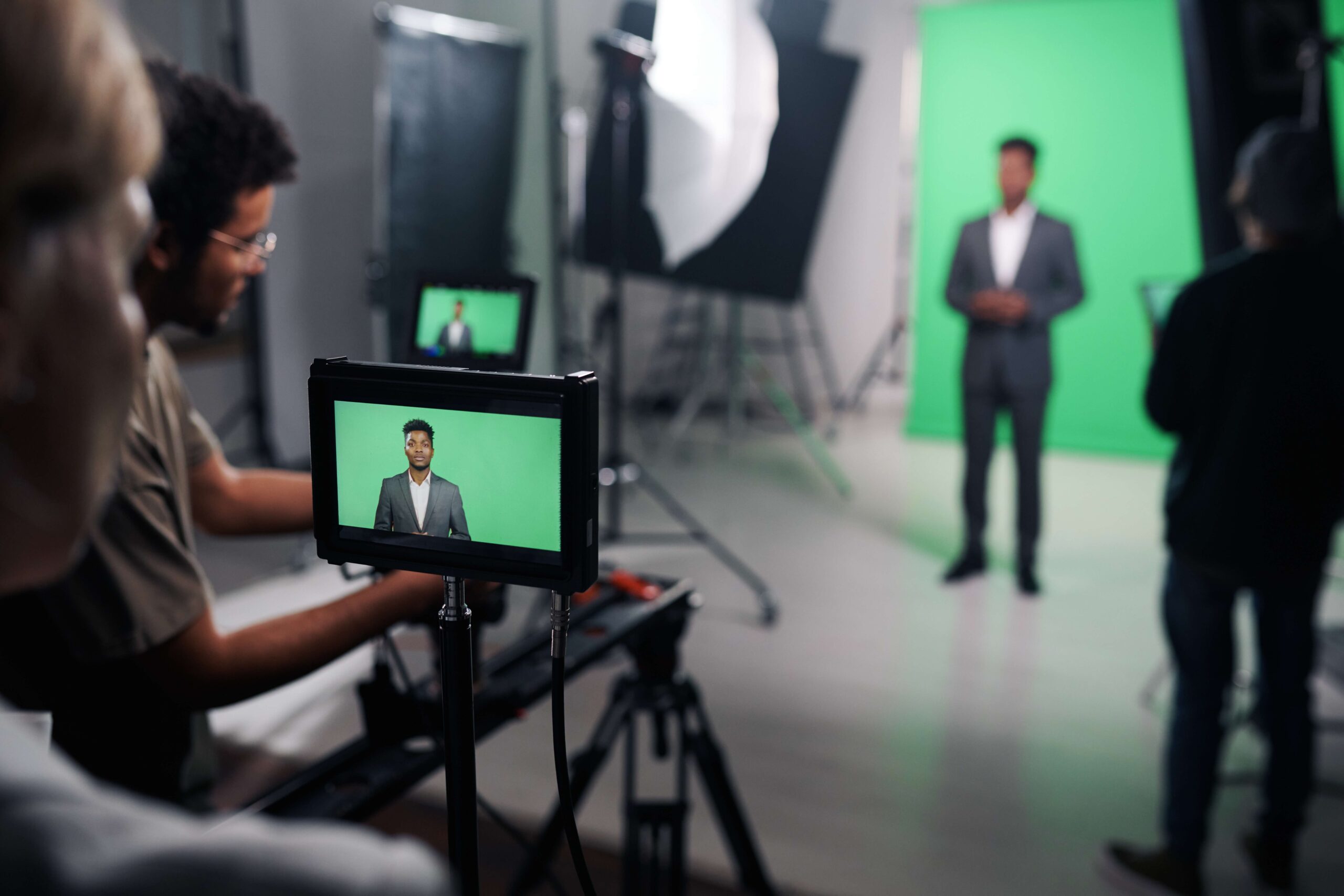
Optimal lighting involves a key light sculpting the subject, a fill light reducing harsh shadows, and a backlight separating the subject from its environment: all of which communicate organizational competence before any words are spoken. Cinema lenses create a shallow depth of field that can be approximated by phone cameras under specific conditions but is far more convincing in controlled settings.
Audio Capture and Room Treatment:
A shotgun microphone positioned above the subject or a lavalier clipped near the throat capture clean dialogue without room reverb, which cannot be adequately corrected in post-production to sound professional. It’s essential to select a suitable recording environment and place microphones strategically during filming: anything less compromises audio quality.
The production values on display serve as a proxy for the organization’s overall standards off-camera.
Interview Techniques & Authentic Capture
Authenticity Shines through when a Genuine Employee Recounts their Work Experience in Person.
There’s an unmistakable distinction between a real employee describing their own work and an actor memorizing lines with perfect delivery. Observant viewers can spot the difference right away. Real individuals on camera often exhibit nervous behavior, but that doesn’t have to be eradicated entirely. Managed correctly, this anxiety translates into genuine sincerity when conveyed on screen.
The Unscripted Interview:
Conversational interviews yield authentic footage by eschewing rehearsed performances. Open-ended questions foster candor, as seen in the query about the team’s most challenging project of recent years, what goes unseen behind the scenes, and how a skipped process might impact results. The subject responds naturally, their unique cadence and terminology making the exchange more persuasive than scripted statements.
B-Roll as Evidence:
To substantiate claims like ‘every weld is pressure-tested before leaving the factory floor,’ accompanying footage is crucial. Witnessing this process firsthand imbues assertions with evidence-based credence. Capturing events at 60 or 120 frames per second adds visual heft to complex actions, making them easier to grasp and appreciate.
Viewers extend the most trust to the hesitation in a voice and to the detail nobody prompted.
Drone & Aerial Cinematography
A Sprawling Complex Unfolds on Screen, Its Sheer Size Only Hinted at from Ground Level.
Seen from above, a large facility tells a different story: a network of logistics and infrastructure. Cranes and warehouses give way to a grid of roads and trucks, each one a tiny part of a much larger machine. Drone footage exists to solve one communication problem, and that problem is scale. Ground-level shots cannot convey it, regardless of lens focal length.
Establishing Scale for Industrial Operations:
Ground level shows a building. Altitude shows the operation. A fleet of 40 trucks lined up outside a distribution center reads as a row of vehicles from the parking lot. At 150 feet of altitude, the same fleet reads as infrastructure and capacity. A construction project three weeks in looks like activity from street level. From above, the footprint, the material staging, and the crew organization are visible in one frame, and the shot answers how big is this operation without a word of narration.
FAA Part 107 and Airspace Authorization:
Commercial drone operations hinge on one critical factor: certification. Without FAA Part 107 clearance, productions expose themselves to serious liability and render their footage unusable in commercial contexts. Flights near controlled airspace may require LAANC airspace authorization with specific altitude restrictions. Flight planning settles which shots are legally achievable, at which altitudes, and in which time windows, before the shoot is put on the calendar.
The aerial shot is establishing context. The ground-level detail shots are the story.
Post-Production & Editing
The Script Determines What Gets Shot. The Edit Determines Whether Anyone Watches Past the Thirty-Second Mark.
The true value of post-production lies in harmonizing disparate elements, pacing, color, sound, and structure to craft a cohesive experience that either captivates or fails to. Attention spans are fleeting; if the visuals don’t hold up, it doesn’t matter how polished the footage is when the cameras stop rolling.
Pacing, Color Grading, and Music Licensing:
Pacing requires deliberate attention: the cadence of cuts in sync with music and narrative progression, where even a single misplaced edit can disrupt the flow. Color grading brings cohesion to disparate shots, aligning visual tone with brand identity across varied lighting conditions and environments. Music licensing is the final safeguard: tracks from libraries like Artlist or Musicbed clear commercial use for a flat annual fee, while unlicensed music invites takedown notices after launch.
Versioning for Platform and Context:
The core asset is a three-minute brand film: every subsequent iteration stems from it. Editing for specific audiences means tailoring length and content: a 90-second homepage version primes viewers for contact; 60-second pre-rolls engage those conditioned to skip, while social cuts focus on different pivotal moments, each 30 seconds long, before the concise 15-second Reel.
Rather than closing out the production, the edit opens the asset’s working life.


Video Distribution Strategy
Where the Video Lives Decides Whether It Earns Anything
A video buried deep inside a website attracts stragglers, not traffic. The video in the homepage hero is in the right place. The video sitting in a shared folder is not. Distribution is what turns a production cost into a return, because the video nobody finds costs exactly as much as the one running on every page of the site.
An undistributed video is a production cost with nothing on the return side of the ledger.
- Homepage Placement and Service Pages: Hero sections with embedded video convey an avalanche of information in under six seconds – exponentially surpassing written copy’s capabilities over thirty seconds. Meanwhile, service pages with incorporated video lengthen user engagement and address specific visitor queries, influencing both search engine evaluations and visitor intent to engage.
- Sales Process Integration: Initiating communication via pre-meeting emails containing video links allows prospects to form a preliminary impression before the first meeting. Embedded videos in PDF proposals can mitigate potential objections that would otherwise arise later, freeing up salesperson time for project specifics and resulting in measurable improvements to close rates and cycle lengths for tracking businesses.

Measuring Video
ROI
A video with zero conversions after 4,000 views is a clear indicator of poor quality content or ineffective marketing strategy.
A short-form video that draws twelve qualified leads from just a few hundred views points the other way, signaling a strong narrative and relevant messaging. Volume metrics measure reach. Business outcome metrics show whether the reach produced anything.
 Retention Rate and Play Rate
View duration provides valuable insights into user engagement patterns. A significant drop-off at the ten-second mark often signals an inadequate hook, failing to capture viewers’ attention. Conversely, a decline in retention at 45 seconds within a 90-second video typically indicates that the content or pacing has lost its momentum before reaching the call-to-action.
 Conversion Lift and A/B Testing
Running an A/B test with and without video on separate landing pages helps isolate its direct impact on conversion rates. The results can vary significantly based on factors like audience demographics, category, and how well the video addresses a specific objection. Pages where the video tackles the primary concern tend to outperform those where it’s merely decorative.

Production Timeline & Investment
Why a One-Day Shoot Carries Three Weeks of Work
The quote that looks inflated for a single day of filming is paying for three weeks of groundwork the client never sees. That work is finished before anyone arrives on shoot day.
Pre-production is where budgets are set in stone. The actual shooting of footage is merely the culmination of decisions made beforehand. Rushing through pre-production proves to be the most costly shortcut in video production.
- Typical Timeline: Script development, location scouting, and storyboard refinement typically consume one to two weeks. Principal photography usually takes just one to two days for corporate projects. Post-production, encompassing rough cuts, client revisions, color grading, sound design, and final delivery, can take up to three weeks.
- Asset Lifespan and Return Calculation: A $2,500 customer testimonial that converts an additional customer per month at a $3,000 average sale pays for itself within the first month. A $8,000 to $20,000 brand anthem on the homepage, in sales presentations, social media content, and proposals works across every touchpoint simultaneously for two to three years before needing an update.
Companies that treat video as a cohesive system reap compounding benefits. Those treating it as a one-off expense are limited to one-time outcomes.

Frequently asked questions
How much does a corporate video cost?
A single-camera testimonial runs $1,500 to $3,000. Multiple locations, drone footage, and motion graphics push a brand anthem into the $8,000 to $20,000 band. The number follows from scope, from how many shoot days are booked, and from the hours spent in post-production. An estimate comes back accurate and quick when the brief is detailed, and slow and vague when the inquiry is general.
How long should a corporate video be?
Homepage brand film: 60 to 90 seconds. Social cuts: 15 to 30 seconds. Training content and case studies sit at 3 to 10 minutes. Length is set by the platform and by what the viewer came for. Someone who went looking for a detailed case study stays for eight minutes, provided the content earns those eight minutes.
Do real employees work better on camera than actors?
For brand stories and testimonials, yes. Those formats run on authenticity, and a real person filmed in their own environment supplies it in a way no trained actor reproduces. Scripted commercials are the exception, since controlled delivery and exact dialogue outrank authenticity there, and actors serve that job well.
Is a script required for interview-style video?
A full script is not required for interviews. Three things are: a question list, a narrative arc, and a target runtime. Show up to a shoot missing any of them and the footage comes back without a story in it. What the shoot failed to capture, the edit bay cannot supply.
How are music rights handled?
Libraries such as Artlist or Musicbed license music, granting perpetual commercial use rights in exchange for a flat annual fee. Music used without a license, popular tracks among them, has not been cleared for commercial use, and YouTube and other platforms answer with copyright claims and takedowns. That claim lands once the video is already published.
Can corporate video be used for television broadcast?
Yes, if shot in 4K with broadcast-spec audio. Comcast and regional cable networks publish local broadcast delivery specs, which come down to exact file formats and audio levels, and post-production needs them in hand before the final export. The footage quality is rarely the constraint. The delivery format specification is.
What is a teleprompter and when should it be used?
The device scrolls script text across the camera lens, letting the speaker read while appearing to address the viewer directly. It suits executive addresses and direct-to-camera statements that depend on exact scripted language. It is the wrong tool for interview-style brand storytelling, where reading flattens the delivery and tells the viewer the words belong to someone else.
Who owns the final video and the raw footage?
Final delivered files, in the agreed formats, belong to the client. Raw camera footage can run to multiple terabytes per shoot day, and the production company keeps it unless the client asks for it and covers the additional storage and transfer fee. Every production agreement treats ownership of the finished edit as standard. Ownership of the raw archive is a separate term, negotiated on purpose.
Can existing footage be incorporated into a new production?
Often yes, provided it is 1080p or 4K, adequately lit, and framed without shake. New material sitting next to technically incompatible footage drags down the perceived quality of everything around it. That call gets made clip by clip once the archive has been reviewed, never up front.
How long does a full production take from start to finish?
Plan on four to six weeks from start to finish. That splits into one or two weeks of pre-production, one or two days of shooting, and two to three weeks of editing with revision rounds built in. When a deadline forces a rush, pre-production is the part that gets cut, and shortchanging that stage is where the costly mistakes tend to surface.
Available in Your City

Google partner
Premiere Agency